
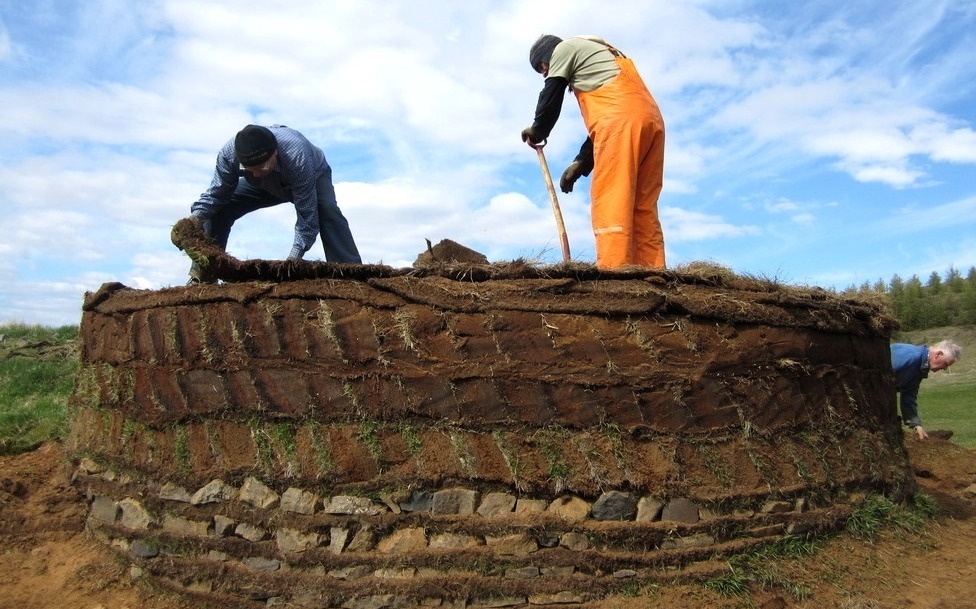
The Heritage Craft School, operated by the Skagafjörður Heritage Museum, was established in 2006 to preserve traditional Icelandic building methods, particularly turf house construction. Through hands-on teaching, research, and the restoration of protected buildings, the school ensures that this rare craft tradition remains alive and is passed on to future generations.
The main emphasis has been on turf and stone construction and timber framing, but courses have also been offered in window-making in collaboration with Fjölbrautaskóli Norðurlands vestra (comprehensive secondary school), driftwood processing, and weaving on a warp-weighted loom.
Participants in the school’s course, both domestic and international, including enthusiasts and professionals in heritage conservation, now number just over 500.
The school has trained nearly 400 participants, both domestic and international, including heritage professionals and enthusiasts.
Courses at the Heritage Craft School are funded through grants, primarily from the Icelandic Cultural Heritage Fund and the Museum Fund. The number of courses offered each year depends on available funding.
The project manager of the Heritage Craft School is Inga Katrín D. Magnúsdóttir.
- Click here to access booklets on turf construction and traditional building techniques.
History
The Skagafjörður Heritage Museum established a dedicated research focus on turf structures and craftsmanship in its 1999 museum strategy, leading to the documentation of turf construction remains in Skagafjörður.
The Heritage Craft School project began in 2006, when an agreement was made with the owners of Tyrfingsstaðir in Kjálki, Skagafjörður, to use the site as a training ground for historic construction techniques. The site contains various turf and stone buildings, including residential structures, outbuildings, and barns. Courses began there in 2007, and since then, most of the school’s workshops have taken place at Tyrfingsstaðir. While Tyrfingsstaðir and the school operate as separate entities, they have greatly benefited from each other’s collaboration.
The establishment of the Heritage Craft School aimed to bridge craftsmanship and architectural heritage, helping to preserve traditional skills used in turf and timber construction. From the beginning, the school’s goal has been to graduate students with practical knowledge and skills in Icelandic traditional building techniques, particularly turf-cutting, turf and stone masonry, woodwork, and metalwork.
Until 2024, the Heritage Craft School operated as a collaborative project between the Skagafjörður Heritage Museum, Fjölbrautaskóli Norðurlands vestra, and Hólar University. At the end of 2024, the partner institutions ended their collaboration, and the Skagafjörður Heritage Museum fully took over the management of the project.
Cultural Heritage Award from the Icelandic Heritage Agency
In 2023, the Heritage Craft School received a special recognition from the Icelandic Heritage Agency for its contribution to the preservation of historic craftsmanship.
The agency’s statement included the following:
“Through its courses, the school has shared knowledge with both heritage professionals and enthusiasts, ensuring the survival of traditional craftsmanship that has been in decline. Understanding old building techniques is essential for maintaining Iceland’s unique turf-building heritage.”
Guðlaugur Þór Þórðarson, the Minister for the Environment, Energy, and Climate at the time, added that this was not just Iceland’s heritage - it belongs to the world. While Iceland has kept the tradition alive, it has largely disappeared elsewhere.
European Heritage Award / Europa Nostra Award
The Heritage Craft School received the European Heritage Awards / Europa Nostra Awards in 2026, Europe’s most prestigious heritage conservation award, for its contribution to the preservation of turf buildings and turf construction methods, which are a unique part of Europe’s architectural heritage.
The Awards’ Jury remarked:
“This project addresses the decline of traditional building skills in Europe through sustained, hands-on transmission of knowledge and practice. It presents a strong intergenerational teaching model that safeguards both the physical structures and the knowledge required to sustain them. Rooted in authenticity and high craftsmanship, and strengthened through international and academic collaboration, the initiative offers a credible model for the preservation of turf-building heritage.”